 AP Biology students from Cardinal Wuerl North Catholic High School visited the Department of Structural Biology at the University of Pittsburgh. Students were led on a tour by Dr. Rieko Ishima, an associate professor and a principal investigator in the department. Dr. Ishima oversees a team of research associates and fellows who are currently working to determine protein structure and dynamics using nuclear magnetic resonance.
Protein images are beyond tiny! The nuclear magnetic resonance spectroscopy of proteins does not ‘take a picture.’ Rather, it relies on complex mathematical calculations to build a three dimensional image of the protein.
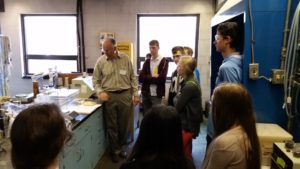
 During Dr. Ishima’s tour, students were shown various equipment used in cryo-electron microscopy, nuclear magnetic resonance, and x-ray crystallography. Students were fascinated not only by the incredible detail achieved in the digital images produced by nuclear magnetic resonance (NMR), but also by the sheer size of the equipment required to generate those results.
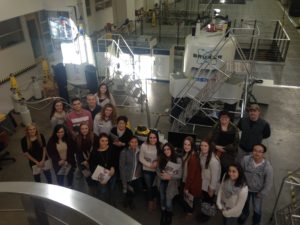 Though NMR examines molecular structure and dynamics at the atomic level, the spectrometers required to view particles that small are extremely large. Pitt has seven spectrometers in this department, and they are housed in 10,000 square foot laboratory. The students were amazed to learn that when the spectrometers were delivered, the first floor windows were removed to allow the equipment to be lowered into the NMR lab! We are standing in front of a two magnets that had to be lowered by crane through an open window.
 Students were also able to tour the cryo-electron microscope facility, where three electron microscopes allow researchers to engage in structural analysis of proteins, viruses, cellular organelles and bacterial cells. Finally, Dr. Ishima and her team led students to the x-ray crystallography lab. Here, researchers are able to grow, store, and monitor crystals. Once crystals are ready for analysis, x-ray beams and image plate detectors are used to collect data about protein structures at the atomic level. While scientists in the lab often use tiny tools to manually transfer crystals for analysis, the lab also is equipped with a robot that can mount and collect data from up to 80 crystals for rapid analysis.
The field is extraordinary.
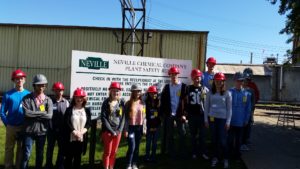 The second day of the 2016 CWNC STEM Careers Tour began with a visit to Neville Chemical located on Neville Island, an island on the Ohio River about 10 miles from Pittsburgh, Pennsylvania. Neville Chemical began in 1925 producing coumarone-indene resin from coke co-products that were being generated from the steel manufactures. During World War II, the company produced many specialty chemicals for the government. In the late 1940’s, Neville saw the development of petroleum cracking units as a new and innovative opportunity. Today Neville Chemical Company is one of the largest produces of hydrocarbon resins and solutions. Neville products are used for the manufacturing of printing inks, adhesives, rubber goods, plastics, paints, coatings, and concrete cure.
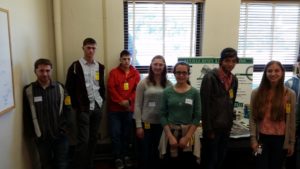
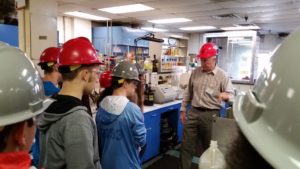 After being outfitted with hard hats and safety glasses, we began our tour of Neville Chemical by walking through the outdoor facility. Our guide was Paul Sauers, manager of raw materials and special products at Neville with over 33 years of experience! He guided us first through the warehouse where we saw hundreds of pallets full of sacks of finished product. Each sack of finished product is labeled with a unique code that enables all of the raw materials that were used to make the product can be traced in case any quality issues occur. We were then led through the outdoor operation facility that consisted of tanks for storing the raw materials, reactors for the polymerization, heat exchangers, distillation columns for separating materials and pipes connecting everything. It was amazing! After learning about the equipment and process for making hydrocarbon resins, we toured the Quality Control Lab that ensures that the finished product meets its desired specifications. Lastly, we visited the Research and Development Lab equipped that focuses on developing new products to meet the needs of the customer and enhancing the current products to be more efficient, safer, and more cost-efficient.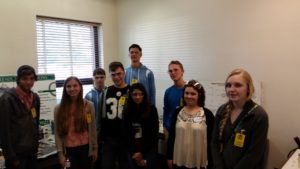
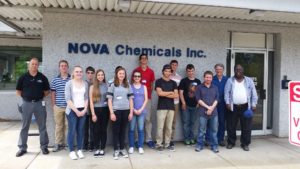 On Wednesday, June 15th, the 2016 CWNC STEM Careers Tour visited Nova Chemicals’ Beaver Valley plant. Nova Chemicals is a leading producers of plastics and chemicals. They develop and manufacture materials for customers worldwide who produce consumer, packaging and industrial products. The Beaver Valley site manufactures expandable polystyrene (EPS) resins and advanced foam resins. It is located in Monaca, Pennsylvania, about 25 miles northwest of Pittsburgh. The site was build by the U.S. government in 1942 as part of the United State Synthetic Rubber Program during World War II and was used for producing synthetic rubber raw materials. In 1955 the site began producing expandable polystyrene resins and in 1983 advanced foam resins. It has transferred through various owners through the years and today, the Nova Chemicals plant is part of the International Petroleum Investment Company of Abu Dhabi. There are about 250 people employed in the manufacturing, technology and commercial departments at Nova Chemicals’ Beaver Valley site.